
ILHAM Student Council
KIDS’ WORKSHOPS
CURRENT PROGRAMME
PAST PROGRAMMES
- ILHAM Art Show 2025
- Skolar Gambar ILHAM
- The Plantation Plot
- ILHAM Conversation: Noor Abed
- Boom Boom Bang: Play & Parody in 1990s K.L.
- ILHAM Art Show 2025: Call for Entries
- Zhang Xu Zhan: Jungle Jungle
- Titik Garis Bentuk: Drawing as Practice
- Hsu Che-Yu: Three Episodes of Mourning Exercises
- Timoteus Anggawan Kusno: Phantoms
- Nirmala Dutt: Statements
- lift the tikar!
- ATAS/NOT ATAS
- Dream of the Day
- ILHAM Art Show 2022
- Kok Yew Puah
- ILHAM Art Show: Call for Entries
- Bayangnya itu Timbul Tenggelam
- The Body Politic and the Body
- Fracture/Fiction
- KL International Photoawards 2019
- Forgotten Thai Masters of Photography
- Chia Yu Chian: Private Lives
- Two Mountains Photography Project
- Latiff Mohidin: Pago Pago (1960 - 1969)
- we will have been young
- PATANI SEMASA
- GRUP 1957-1973
- ILHAM Contemporary Forum
- Afterwork
- Era Mahathir
- Love Me In My Batik
- Picturing The Nation
PROGRAMMES VIDEOS


Robert Rauschenberg and Asia
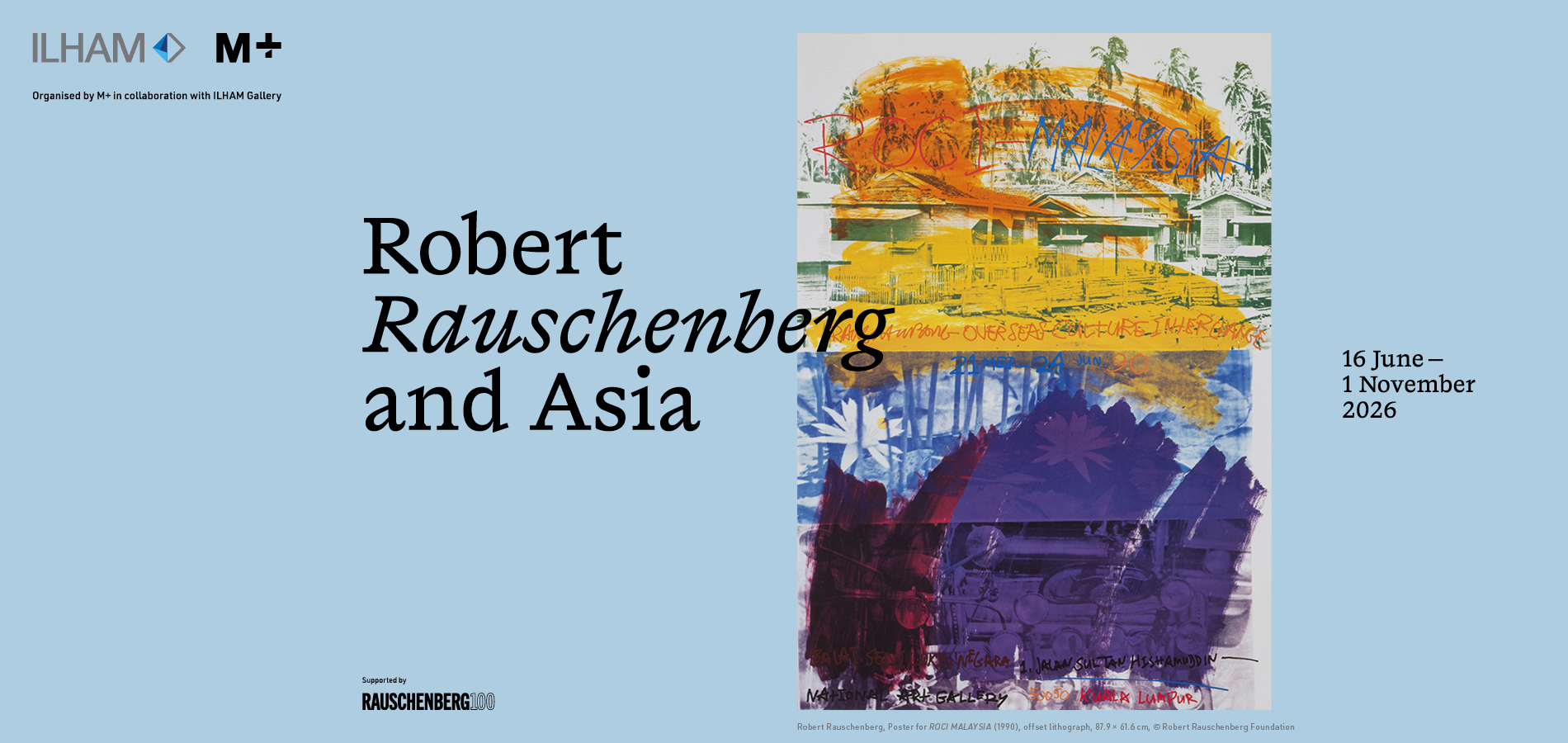
'Merantau' & Its Frictions: Dialogues with Rauschenberg, ROCI, and Malaysia
This series of programmes positions Robert Rauschenberg's ROCI MALAYSIA (1990) exhibition as a historical catalyst for an open dialogue. Using the regional lens of merantau (mobility, transformation, and cross-cultural encounter), these programmes create a live conversation between Rauschenberg's archival legacy and contemporary Malaysian practitioners exploring images, material waste, sound, and space.
June
Curatorial Walkthrough
with Russell Storer
14 Jun 2026, 2:30pm (Level 5)
Join us as we walk through the Robert Rauschenberg and Asia exhibition with Russell Storer, Senior Curator and Associate Director of Curatorial Affairs, M+. Free entry.
Please note that this event is fully subscribed.
July
The Material Combine: Sifting Image Saturation
Workshop facilitated by Azam Aris (Chetak 17) and Sanan Anuar (Studio Bogus)
11 Jul 2026, 2:00pm – 5:00pm (Gift Shop)
Walk-ins welcome
A silkscreen workshop inspired by Rauschenberg's foundational concept of the 'Combine' and his practice of silkscreening found media images directly onto alternative, everyday surfaces like tin-plated steel during his Malaysian tour. Fees to join: RM120. Email info@ilhamgallery.com to register.
Merantau of Meaning: Translation, Transfer, and the ROCI MALAYSIA Catalogue
Talk by Pauline Fan
18 Jul 2026, 3:00pm (Level 5)
To merantau is to leave home with the expectation of return, changed by what is encountered along the way. Rooted in Minangkabau tradition, merantau has become part of the cultural sensibility of the Malay world, a way of thinking about movement, encounter, and transformation. Rauschenberg's decade-long ROCI project, which sought dialogue through art across continents, might be understood as a merantau of its own.
The 1990 ROCI Malaysia catalogue appears as a single publication in Malay. Yet it is the product of multiple acts of translation. Donald Saff's introduction and Robert Hughes's 1976 essay, both originally written in English, were translated into Malay to sit alongside Muhammad Haji Salleh's own writing. The work of translation is largely invisible, leaving little trace of the movement between languages.
This session uses the catalogue as a starting point for thinking about translation more broadly. What travels when meaning moves between languages? What is lost or gained in the process? Rauschenberg's own practice offers a parallel. His solvent-transfer technique carried images from one surface to another, altered in the process, while his choice to give certain works Malay titles, Yang Teragung and Hutan Belantara, suggests translation not simply as conversion, but as an act of making meaning in a new place.
Pauline Fan is a literary translator and Creative Director of PUSAKA.
August
Malady & Remedy: Orang Asli Art Engaging with Ecological Crises
Talk by Wendy Sia (Gerimis Art Project)
1 Aug 2026, 3:00pm (Level 5)
In 1970, Robert Rauschenberg designed the first Earth Day poster, featuring an American bald eagle at the centre of a collage of environmental decay. Born and raised in a Texas oil town and later settling on the remote Floridian island of Captiva, he witnessed environmental destruction firsthand and believed that "art can encourage individual conscience." This session considers how Orang Asli artists and cultural custodians respond to the ongoing ecological, material, spiritual, and cosmological disruptions affecting their ancestral lands, revealing truths otherwise unspoken and unwritten.
Art as a catalyst for social change
Lecture by Jo Kukathas
8 Aug 2026, 3:00pm (Level 5)
What is the purpose of art in society? One of Rauchenberg's fundamental beliefs was that art should serve as a catalyst for social change. This lecture by acclaimed theatre practitioner Jo Kukathas aims to explore the role of art in the formation of a more humane and inclusive dialogue.
Ecologies, Vectors, Vicinities: Conversations on art writing across registers in Southeast Asia
22 Aug 2026, 2:00pm (Level 5)
Discourses around textual production in Southeast Asia have been framed in terms of lack—lack of critics, lack of platforms and publications or their unsustainability, lack of support or lack of infrastructure to sustain critical activity. Instead of belaboring this lack, Ecologies, Vector, Vicinities proposes to recognize how, in the context of the region, notions of lack have forced and enabled practitioners to imagine different forms, registers, dispositions, and circulations of textual production. From this notion of lack, writing is transformed into dispersive efforts: online journals, zines, writing workshops as public programing, writing as a curatorial framework, to identify a few.
The conversation gathers writing practitioners of various persuasions: critical, curatorial, art historical, artistic, among others, to think about and annotate contemporary art writing in the region. Speakers include Lee Weng Choy (Independent Art Critic), Patrick Flores (Chief Curator, National Gallery Singapore), Roger Nelson (Co-founding co-editor, Southeast of Now), and Grace Samboh (founding member, Hyphen—).
Ecologies, Vector, Vicinities is part of the bigger programme of the same title which includes a writing workshop with art writers in the region. Ecologies, Vector, Vicinities is co-convened by ILHAM and Carlos Quijon, Jr., with support from SAM Fund for Arts and Ecology, Monsoon Southeast Asia Collection, and DIB Bangkok.
Limited places, please email info@ilhamgallery.com for a confirmed seat.
Book Launch: Philippine Figurine: Image, Art, Ornament
by Patrick Flores, in collaboration with National Gallery Singapore
22 Aug 2026, 5:00pm (Level 5)
ILHAM will be hosting the launching of the book Philippine Figurine: Image, Art, Ornament by art historian and curator Patrick Flores, organised in collaboration with the National Gallery of Singapore. Philippine Figurine is the newest title in the Art Writing series of NGS Press. Speakers at the launch will include Carlos Quijon, Jr., Eric Goh, and Patrick Flores.
Limited places, please email info@ilhamgallery.com for a confirmed seat.
September
An American Pragmatist: Robert Rauschenberg in Malaysia and Singapore
Lecture by Kathleen Ditzig
26 Sep 2026, 3:00pm (Level 5)
The Rauschenberg Overseas Culture Interchange (ROCI)'s presentation in Malaysia in 1990 was not the first nor the first nor last presentation of Robert Rauschenberg's artwork in Southeast Asia. His work was presented in the region in travelling group exhibitions of American Art in the 1960s and 1970s, and was presented in Malaysia through the 1990s. In 1997, Kuala Lumpur-based TAKSU gallery and Singapore based Wetterling Teo Gallery collaborated on the presentations of a solo exhibition of the artist's work in Malaysia and Singapore. The press release described Rauschenberg as an "American Pragmatist." Focusing on the presentation of Rauschenberg's art in Malaysia and Singapore, this lecture traces the discursive framing of Rauchenberg as an "American Pragmatistic" in relation to the evolving local and international urgencies that defined the presentation of Americn art in Southeast Asia at the end of the Cold War.
Research for this lecture was enabled by M+ Museum's Rauschenberg and Asia and a fellowship at the Robert Rauschenberg Foundation Archives in 2025.
Kathleen Ditzig (PhD) is a Singaporean curator and art historian whose work examines the infrastructure and geopoliticals of art worlds, and the legacies of the US Cultural Cold War in Southeast Asia. In particular, she has written about significant exchanges between Southeast Asian artists and American artists as well as the travel of American art through Southeast Asia. She is a curator at National Gallery Singapore where she works on the museum’s first AI commission and researches art histories of technology from a Southeast Asian perspective
October
Creole Biographies, Sacred Seascapes and Cosmopolitanism in the Malay World
Talk by Dr. Sumit Mandal (Author of Becoming Arab: Creole Histories and Modern Identity in the Malay World)
24 Oct 2026, 3:00pm (Level 5)
The sea shaped the Malay world profoundly for millennia and has been rendered more and more distant from us in the past two hundred years. This lecture examines the nineteenth-century biography and a travelogue of Ahmad Rijalluddin to explore how the sea shaped the author. He was of Malay-Chulia descent and thus creole (or peranakan) like his near contemporaries Abdullah al-Misri and Abdullah Munshi, who were respectively Malay-Arab and Chulia-Arab. While their creole biographies wove a web of connections to distant parts of the Indian Ocean, these authors were at home in the Malay world as familiar strangers whose multi-lingualism, trading and diplomatic skills, and mobility helped to shape the archipelago’s cosmopolitanism. Ahmad Rijaluddin’s account of his journey from Penang to Kolkata in 1810, Hikayat Perintah Negeri Benggala, is suffused with references to the sea and steeped in a cosmology of the seascape. Through the travelogue, we are able to appreciate how much the sea remained central to the cultural imagination even as European imperial powers adopted a landward orientation as they grew in presence and reach. Ahmad Rijaluddin’s biography and travelogue offer insights into a cosmopolitanism whose relevance – and perhaps even influence – on the present may be more significant than we think.
Sumit Mandal is Muhammad Alagil Chair in Arabia Asia Studies at the Asia Research Institute, National University of Singapore. He is a historian who researches the outcome of longstanding inter-cultural and inter-religious interaction in the Malay World – understood as a flexible and expansive cultural geography. His book Becoming Arab: Creole Histories and Modern Identity in the Malay World (Cambridge, 2018) reconsiders colonial and national understandings of the indigenous and foreign by substantiating what were significantly intermixed societies. He is currently doing research on keramat (Muslims shrines) in the Malay world as inscriptions on the landscape of a sacred history that provoke a reimagination of the Islamic Indian Ocean.
ILHAM Kids' Programmes
Ever wanted to take your child to an art gallery but didn't know where or how to start?
Come awaken your child's sense of wonder, as well as your own by signing up for our popular Ilham Kids' Art Discovery Tours that are kickstarting again in October 2026 in conjunction with the latest show: “Robert Rauschenberg and Asia” that will be exhibiting until 1 November 2026.
Robert Rauschenberg (1925-2008, U.S.A) is widely acknowledged as one of the most innovative and influential artists of the twentieth century. His work foreshadowed many major developments in post-war art such as Pop Art, Conceptual Art, and installation art. His experimental practice redefined what an art object could be, incorporating everday items and mass media images into his works, and blurring the line between painting and sculpture.
More than just another art class, ILHAM Kids’ tour series presents a gentle first encounter with fine art focuses on cultivating art appreciation and creativity in children within the context of current exhibitions at the Ilham Gallery. Perfect for locals and visitors looking to connect with contemporary Malaysian art together with their kids, our play date styled tour is designed to give 7 to 12 year olds a chance to engage with the Malaysian and larger regional art scene, interpret ideas, and even create their own art works in a facilitated environment.
To register, please drop us an email at ilhamgallerykids@gmail.com with your child's name and age. Fee is RM65 per child (must be accompanied by a parent) or RM60 per child if coming with a sibling. The minimum number for each tour to proceed is 10 children and each tour limited to a maximum of 14 children per tour. This fee includes the tour of the current show, discussions on key selected artworks as well as a related art making activity at the end.
The public tour dates are as follows:
1. Sunday, 4 Oct 2026, 10:30am – 1:00pm
2. Sunday, 11 Oct 2026, 10:30am – 1:00pm
3. Sunday, 25 Oct 2026, 10:30am – 1:00pm
4. Sunday, 1 Oct 2026, 10:30am – 1:00pm
School group tour dates are also available for reservation, please enquire at the same email ilhamgallerykids@gmail.com.


2015-2026 © ILHAM GALLERY. ALL RIGHTS RESERVED. WEB DESIGN BY TOMMY NG