
CURRENT EXHIBITIONS
UPCOMING EXHIBITIONS
PAST EXHIBITIONS
- The Bouquet and the Wreath (Rebirth)
- The Plantation Plot (2026)
- ILHAM Art Show 2025
- Colorless, Odorless
- menggodam
- The Plantation Plot
- POLLINATION 4: the palms of y/our hands
- Ekin Kee Charles: Meet Us at the Ridge
- Boom Boom Bang: Play & Parody in 1990s K.L.
- A Night We Held Between
- Zhang Xu Zhan: Jungle Jungle
- Titik Garis Bentuk: Drawing as Practice
- Hsu Che-Yu: Three Episodes of Mourning Exercises
- Nirmala Dutt: Statements
- Timoteus Anggawan Kusno: Phantoms
- lift the tikar!
- Dream of the Day
- Projek 555
- ILHAM Art Show 2022
- Skola Gambar Enrique de Malacca
- Kok Yew Puah
- Bayangnya itu Timbul Tenggelam
- HOMEBODY
- KLPA 2020
- The Body Politic And The Body
- Domestic Bliss
- Fracture/Fiction
- Kuala Lumpur International Photoawards 2019
- Forgotten Thai Masters of Photography
- Chia Yu Chian: Private Lives
- Two Mountains Photography Project
- Latiff Mohidin: Pago Pago (1960 - 1969)
- we will have been young
- Patani Semasa
- GRUP 1957-1973
- ILHAM Contemporary Forum
- JP Soetardjo Menjawab Semua Soalan
- Afterwork
- Era Mahathir
- Love Me In My Batik
- Picturing The Nation
VIRTUAL TOURS
- The Plantation Plot
- Boom Boom Bang
- Titik Garis Bentuk
- Nirmala Dutt: Statements
- Dream of the Day
- ILHAM Art Show 2022
- Kok Yew Puah
- Bayangnya itu Timbul Tenggelam
- The Body Politic And The Body
EXHIBITIONS PHOTOS


until today to enjoy this land
In collaboration with Kala Kulo, Nepal
Opens 12 December 2026 (Level 5)
The enduring presence of Nepali communities across Southeast Asia reveals a history shaped by mobility amid persistent political turbulence: the deployment of Gurkha soldiers under the British Empire; the settlement and displacement of communities in Myanmar; and today’s mass labor migration to Malaysia and across Asia’s emerging markets. This current surge in labor supply is often described through superlatives: billions in remittances, millions employed, a hundred nations reached. But beneath these "unrivaled" figures lies a system still mired in the logic of colonial extraction, reality where the export of its own citizens is woven into the very economic fabric of the Nepali state.
The popular narrative that Nepal was never colonized often obscures historical pressures that forced many to leave. While this discourse served as a powerful tool for the monarchy, it failed to acknowledge the systematic recruitment and exploitation of Nepali peoples under the British Empire. Across South and Southeast Asia, the British funneled bodies into tea plantations, mines, and trenches. During the World Wars, hundreds of thousands of soldiers, drawn primarily from Gurung, Magar, Rai, and Limbu Indigenous communities, were deployed as political subjects of the Crown. Many were laid to rest in foreign soil without recognition, their lives defined by servitude that continues to shadow the present.
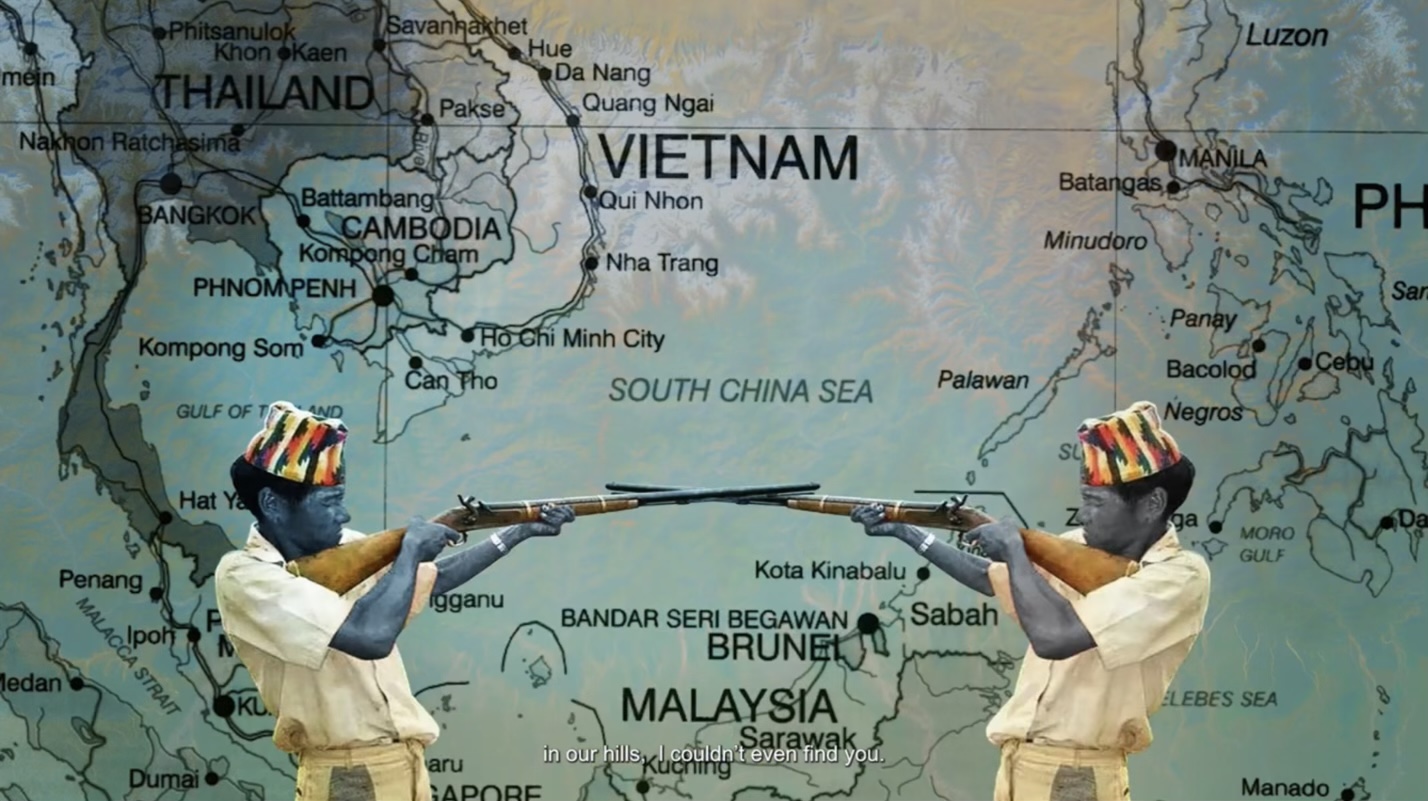
The legacy of Nepali labor in service as security personnel persists in Southeast Asia is evidenced by the Gurkha Contingent of the Singapore Police Force, the Gurkha Reserve Unit of Brunei, and the ubiquitous employment of Nepali security personnel throughout Malaysia. Yet, beyond these formalized military and paramilitary entanglements, many attempted to root themselves, laboring to survive in geographies far from their ancestral homes while clinging to the fragile, and often elusive, dream of making a new home.
The title of this exhibition draws from one such account of displacement from Indra Bahadur Rai’s short story, The Long March Out of Burma. In it, the protagonist Jayamaya learns of the impending Japanese occupation during the Second World War from her father, Subedar Shivajit Rai, a Gurkha who had chosen to settle in Myitkyina. His words serve as a haunting refrain for the fragmented history of the Nepali diaspora in Myanmar: "If Gorkhas have only until today to enjoy this land, so be it. But, if fortune still keeps us in favour, we will return to and share laughter and joy."
To question the constructs of nation, belonging, and placemaking, there is need to situate "informal" histories and identities that have often emerged in the fractures of modern state formation. After the end of the Nepali monarchy in 2008, there was a drastic rise in the number of labor permits issued for foreign employment. In nearly two decades this network has expanded across Asia, especially in the Gulf states and Malaysia; in the latter alone over 500,000 Nepali migrants work across manufacturing, security, hospitality, and plantations, constituting the second largest migrant community.
In the wake of these incessant departures, Nepali society is undergoing a major restructuring where the predominantly male exodus has shifted the mantle of responsibility to the women who remain at home. This transition has fostered grassroots collectives and the reclamation of ancestral systems that were once sidelined. As women revive older frameworks of belonging and integrate them with newer forms of cooperatives, they are actively reimagining community through a lens of resilience and tactile care in the absence of men.
Traced across two centuries of migratory displacement, this exhibition examines a trajectory defined by transience and the cyclicity of return. Bringing together a diverse array of voices whose lives have been directly shaped by these migratory currents, the artists center narratives of persistence, aspiration, joy, and connection, moving beyond flattening statistics of suffering. It is also an attempt to reclaim the dignity of those whose presence is reduced within the global machinery of capital and recognize vital relational nuances which remain foundational to how we operate as a society.
The exhibition willfeature artists from Nepal and Malaysia including Hit Man Gurung, Suzana Shrish, Priyanka Singh Maharjan, Hoo Fan Chon, and Okui Lala.


2015-2026 © ILHAM GALLERY. ALL RIGHTS RESERVED. WEB DESIGN BY TOMMY NG